
Nanobubble technology: what it is, and what it does not do
A plain-language guide for engineers and municipal officers deciding whether a nanobubble pilot is worth running.
What is a nanobubble?
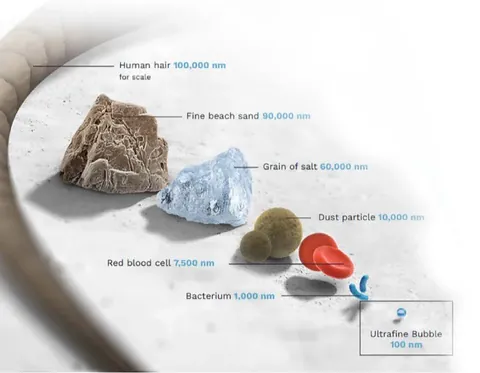
A nanobubble is a gas-filled cavity in water that is smaller than 200 nanometres across. A nanometre is a billionth of a metre. Standards such as ISO 20480-1 group bubbles under 1 micrometre as "ultrafine"; in this industry the smallest of them are called nanobubbles, and we use the word for bubbles under 200 nm.
For scale, a fine-bubble diffuser makes bubbles of 1 to 4 mm, and coarse or surface aerators 4 to 10 mm or more. The picture shows how small that is next to everyday particles.
Why they behave differently
They do not rise quickly
Buoyancy pushes a bubble upward. The smaller the bubble, the weaker that push, and below a certain size random motion in the water can keep a bubble suspended. A coarse bubble leaves the water in seconds; a nanobubble can stay in the water column for much longer.
They carry a surface charge
Nanobubbles typically carry a negative charge on their surface. Like charges repel, which discourages bubbles from merging into larger ones that would rise and escape.
They have a very large surface area for their volume
Gas moves into water across the bubble surface. A given volume of gas split into nanobubbles has far more surface than the same volume in coarse bubbles, so more of it can dissolve.
In practice: three jobs in water treatment
Raising dissolved oxygen is the first job, and the one most of our pilots rest on. The second is helping biological treatment, because aerobic bacteria that break down organic matter and ammonia need oxygen to work. The third is oxidation, because nanobubbles generate hydroxyl radicals.
They generate hydroxyl radicals
Nanobubbles generate hydroxyl radicals. These are highly reactive and can help break down contaminants in the water.
Nano, micro and fine bubbles compared
| Property | Nanobubble | Fine-bubble diffuser | Coarse or surface aerator |
|---|---|---|---|
| Typical diameter | Under 200 nm | 1 to 4 mm | 4 to 10 mm or more |
| Behaviour in water | Stays suspended; does not rise quickly | Rises to the surface in seconds | Rises and bursts at the surface |
| Where oxygen goes | More dissolves into the water column | Part dissolves, part escapes | Most escapes to air |
Microbubbles sit between the two: tens of micrometres across. They rise faster than nanobubbles and slower than fine-bubble diffuser output.
What nanobubbles do not do
- They do not replace source control. A lake that receives untreated sewage will keep degrading.
- They do not always raise dissolved oxygen. At Pirana, oxygen nanobubble treatment of raw sewage left dissolved oxygen essentially unchanged (6.4 to 6.2 mg/L), while COD and BOD fell sharply.
- They are not a stand-alone cure. Lake projects usually add source control, probiotics or skimming.
- Results do not transfer automatically. They depend on the water, the load and the layout, which is why we pilot first.
What we have measured
Four reports from our own pilots are on the case studies page. Together they cover a sewage bench trial, stadium irrigation water and two fish-farming trials. Each states its limits. Our lake project at Rao Talao is ongoing, so it has no results yet.
Sources
- ISO 20480-1:2017, Fine bubble technology: general principles for usage and measurement of fine bubbles, Part 1: terminology.
- Avior Aqua pilot reports, linked from each case study.
Where nanobubbles are used
Our work so far falls into four areas. Each page links to the data behind it.
- Lakes and ponds. Low dissolved oxygen and a heavy organic load are the usual problems, and nanobubbles are one tool alongside source control.
- Sewage and effluent plants. Extra oxygen in aeration tanks and polishing steps, without building new tanks.
- Fish ponds and tanks. Steadier oxygen through feeding peaks and warm nights, when fish need it most.
- Turf and stadiums. Treating irrigation water before it reaches the pitch.
In each, the first step is the same: measure the water, agree a target, and test on part of the system before committing to more.
Reading the evidence
A single pilot shows what happened on one site. Several pilots that point the same way are a reason to test further, not proof. We show the scale, the controls and what else was changed for each study so you can judge the result yourself.
How nanobubbles are measured
Bubbles this small cannot be seen, so size claims depend on instruments. Laboratories commonly use nanoparticle tracking analysis or dynamic light scattering to estimate size and concentration. Both have limits: they can mistake tiny solid particles for bubbles, and the result depends on sample handling. A credible size claim says which method was used, on which sample and when.
On our sites we have so far measured water chemistry rather than bubble size. The "under 200 nm" figure describes the design of the nanobubble generator and the definition we use. We do not publish a measured size distribution, and we say so rather than imply one.
Questions to ask any nanobubble supplier
- How was bubble size measured, on what sample, and by whom?
- Which gas was used, and where did it come from?
- Was there a control, and was it run under the same conditions?
- What else was done to the water at the same time?
- Was power use metered, or estimated from a nameplate?
- Which results went the wrong way, and why?
- Who tested the samples, and how many were taken?
We put these questions to our own pilots. The answers, including the unflattering ones, are in each case study.
Nanobubble FAQ
Do nanobubbles really work?
Our pilots show measurable changes in dissolved oxygen and in some pollutant measures, but each has limits: bench scale at Pirana, different operating conditions in the Tengra tanks and no control pond at Nadipar. We read them as promising field evidence, not proof for every site. Read the evidence review.
How long do nanobubbles last in water?
Published studies report a wide range of lifetimes depending on the gas, salts, temperature and water chemistry. We have not measured bubble lifetime on our own sites, so we do not quote a figure.
How do nanobubbles work in water treatment?
They raise dissolved oxygen, which supports aerobic bacteria that break down organic matter and ammonia. Nanobubbles also generate hydroxyl radicals, which help break down contaminants.
What is the difference between nano, micro and fine bubbles?
Size. Nanobubbles are under 200 nm. Microbubbles are tens of micrometres. Fine-bubble diffusers make bubbles of 1 to 4 mm. Smaller bubbles rise more slowly and expose more surface area per unit of gas.
Can nanobubbles clean a lake on their own?
No. They treat the oxygen and organic-load side of the problem. If untreated sewage keeps flowing in, the lake will keep degrading. Lake projects usually add source control, probiotic dosing or skimming alongside the nanobubble generators.
Want to test it on your water?
We start with an assessment and a pilot with agreed measurements.