
Ozone water treatment: how it works, where it fits, what to watch
Ozone is oxygen with a third atom, and that third atom makes it one of the strongest oxidants used on water. It kills bacteria and viruses, breaks down colour and odour, and turns dissolved iron and manganese into particles a filter can catch. It also disappears quickly, which is both its main advantage and its main limit. This page explains how ozone treatment works, where it fits better than chlorine, what to watch for, and why the size of the bubble carrying it matters.
What is ozone water treatment?
Ozone water treatment dissolves ozone gas, made on site from air or oxygen, into water to disinfect it and oxidise colour, odour, organics, iron and manganese. Ozone breaks down quickly and leaves no residual to remove, so it suits treatment before use or discharge.
How ozone is made and dissolved
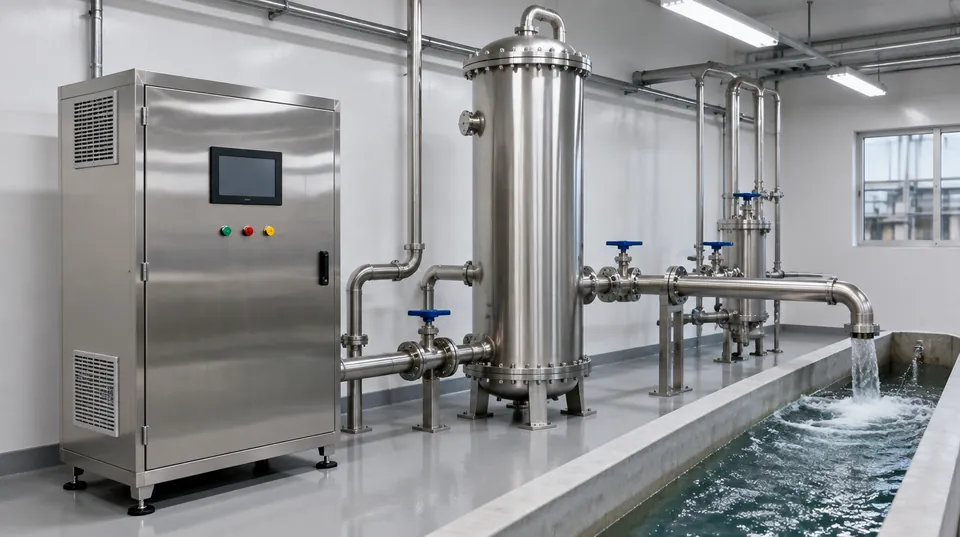
Ozone cannot be stored or delivered in cylinders, because it breaks down too quickly. It is made where it is used: an oxygen-bearing gas, either dried air or oxygen from a concentrator, passes through a high-voltage discharge of about 6 to 20 kV. The gas is then dissolved into the water in a contact tank or a side stream.
Dissolving is the hard part. Ozone is only partly soluble, and conventional contactors use bubbles about 2 to 6 mm across that rise quickly and carry gas out of the water. Any ozone that is not dissolved leaves as off-gas, which has to be destroyed before release.
Ozone vs chlorine vs UV
| Feature | Ozone | Chlorine | UV |
|---|---|---|---|
| How it works | Strong oxidant | Oxidant, weaker than ozone | Light damages microbes' DNA |
| Colour, odour, organics | Breaks many down | Limited | No effect |
| Residual in the water | None lasting | Yes | None |
| Chemicals to store | None; made on site | Yes | None |
| Watch for | Bromate where bromide is present; off-gas | Chlorinated by-products | Needs clear water |
| Equipment | More complex | Simple | Simple |
The choice is rarely either-or. Ozone often does the heavy oxidation and disinfection, and a small chlorine residual protects the water afterwards where a residual is needed.
Where ozone is used
- Sewage and effluent polishing: tertiary disinfection, colour and odour. In textile effluent, ozone is used mainly for colour; see textile ETP.
- Swimming pools: ozone in the circulation loop handles most of the oxidation, so the pool runs on a much lower chlorine level.
- Cooling towers: an oxidant against biofilm; see cooling tower water treatment.
- Iron and manganese removal: ozone oxidises them so a filter can catch them.
- Process and wash water: in food processing and other industries, where an on-site oxidant without stored chemicals is useful.
Is a chlorine-free swimming pool possible?
Mostly, not completely. Ozone in the filtration loop does most of the work chlorine normally does, and pools that use it run on far less chlorine. Because ozone leaves no lasting residual, most systems still keep a low chlorine level in the pool water itself to protect swimmers between passes.
What to watch with ozone
- Bromate. Ozone can turn bromide in the water into bromate, a regulated by-product. Test for bromide before designing an ozone system.
- Safety. Ozone gas is toxic to breathe. Systems need leak detection, ventilation and off-gas destruction.
- Dirty water. Water with high suspended solids, BOD or COD uses up ozone; treat it first.
- No residual. Plan for what protects the water after ozone, if anything must.
Why smaller bubbles carry ozone better
Smaller bubbles have more surface for their volume and rise more slowly, so more ozone dissolves before the gas escapes. In a direct comparison under identical conditions, microbubbles transferred ozone 1.6 times better overall than conventional bubbles. The same study found that, for the ozone actually dissolved, smaller bubbles made no extra bromate: the gain is in getting ozone into the water, not in changing its chemistry.
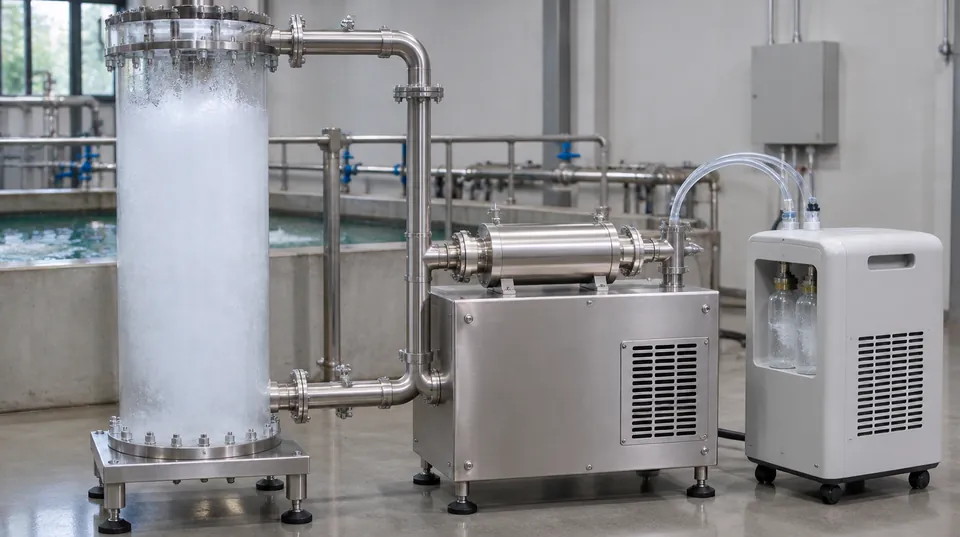
Nanobubble generators take this further with a side-stream skid: a pump draws water, ozone is dissolved into it as fine and nanobubbles, and the water returns to the tank. Avior's NanOzone makes its ozone from concentrated oxygen: its output in grams per hour is 8 times the oxygen feed in litres per minute. The system is described on the generators page.
What to send us
- What the water is: sewage, effluent, pool, cooling, process or wash water
- Flow rate and hours a day
- What ozone should do: disinfect, remove colour or odour, oxidise iron or manganese
- Recent analysis, including bromide if known
- Any treatment already in place
Ozone water treatment: FAQ
Is ozone better than chlorine for water treatment?
It is stronger and adds no chemicals to store, and it breaks down colour and odour that chlorine leaves. But it leaves no lasting residual, so where water must stay protected afterwards a small chlorine residual is often kept. Many plants use both.
Is ozone-treated water safe?
Ozone breaks down quickly and leaves no residual to remove. The two checks are bromate, where the water contains bromide, and safe handling of ozone gas around the equipment.
What size ozone generator do I need?
It depends on the flow and on how much ozone the water uses up, which varies with its organic load and what you want removed. We work out the grams per hour from your analysis and, where needed, a short trial. On a NanOzone, ozone output in g/h is 8 times the oxygen feed in LPM, so the oxygen supply is sized from that.
Thinking of ozone instead of chlorine?
Tell us what the water is, the flow, and what you want ozone to do: disinfect, remove colour or odour, or something else. We reply within one working day.
Thinking of ozone instead of chlorine?
Tell us what the water is, the flow and what you want ozone to do. An engineer will say whether ozone fits, and whether a short trial is worth running.