
Cooling tower water treatment: scale, biofilm and blowdown
A cooling tower is a water concentrator that happens to cool. Every hour it evaporates clean water and leaves the salts behind, while warm, wet fill and basins invite slime and bacteria. Left alone, the result is scale on the condenser, biofilm in the pipework and a chiller that works harder every month. This page explains how cooling water goes wrong, how plants keep it in control, and where nanobubbles may fit.
What does cooling tower water treatment do?
It keeps four problems in check: scale from salts that concentrate as water evaporates, biofilm and algae, corrosion, and Legionella. Plants control them with blowdown, scale and corrosion inhibitors, biocides and filtration, and track the results with conductivity, hardness and bacteria counts.
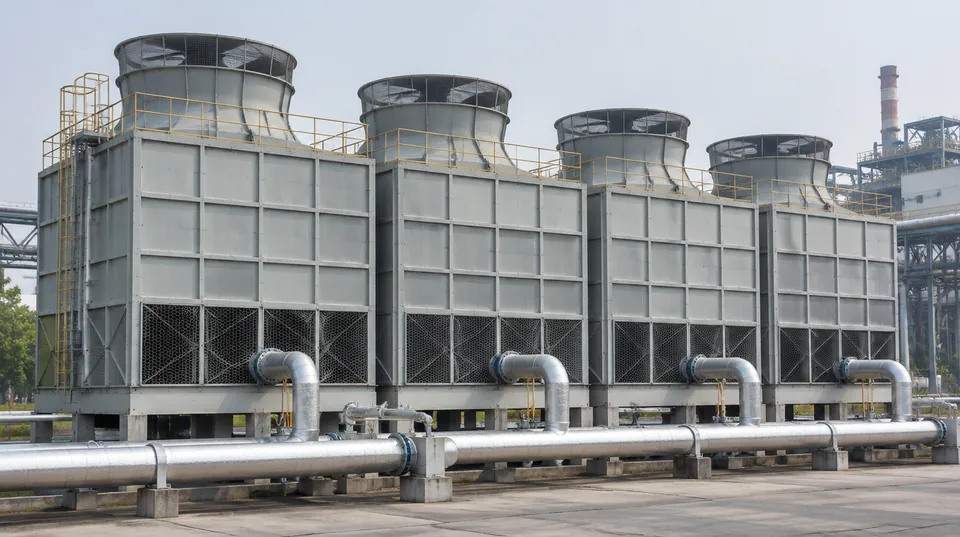
Why cooling tower water goes bad
| Problem | What causes it | What it costs you |
|---|---|---|
| Scale | Calcium carbonate and silica concentrate as water evaporates | Scale forms first on the hottest tubes and cuts heat transfer |
| Biofilm and algae | Warm, wet, sunlit surfaces and nutrients in the water | Insulates tubes, hides corrosion, shelters Legionella |
| Corrosion | Oxygen, low pH, high salinity, and deposits that trap water against metal | Leaks, tube failures, shorter equipment life |
| Legionella | Water held between about 25 and 45 °C | A health risk to people near the drift |
The four feed each other. Scale gives biofilm somewhere to anchor, biofilm hides corrosion under it, and corrosion products roughen the surface for more scale. Treating one alone rarely holds.
What are cycles of concentration?
Cycles of concentration (COC) is how many times the dissolved salts in the circulating water exceed those in the make-up water, usually read as a conductivity ratio. Higher COC saves water, because less is bled off, but brings the water closer to scaling. Every cooling programme is a balance between the two.
Blowdown is roughly the evaporation divided by (COC minus 1). Running at 3 cycles bleeds off half as much water as the tower evaporates; at 6 cycles it bleeds one fifth. Better scale and biofilm control is what lets a plant run more cycles safely.
How plants treat cooling tower water today
- Blowdown controlled by a conductivity setpoint.
- Scale and corrosion inhibitors, dosed in proportion to make-up water.
- Biocides: an oxidising biocide such as chlorine or bromine, often alternated with a non-oxidising one.
- Side-stream filtration to take out suspended solids.
- Monitoring: conductivity, pH, hardness, alkalinity, a dip-slide or ATP bacteria count, and the approach temperature on the heat exchangers.
The weak point is biofilm. Bacteria living inside it resist biocide far better than bacteria floating free in the water, so a basin can test clean while the tubes stay fouled.
Can nanobubbles treat cooling tower water?
The evidence is promising but early. A 2021 review sets out why nanobubbles may act as chemical-free inhibitors of calcium carbonate and silica scale and of corrosion, and notes that the effect depends on water chemistry. Field data for cooling towers so far comes mainly from equipment suppliers, not independent studies.
What a nanobubble generator adds is a side-stream skid: a pump draws water from the basin, gas is dissolved into it, and the water returns. Nothing is dosed into the water except the gas. With oxygen or air it raises dissolved oxygen; with ozone it adds a strong oxidant against biofilm. Ozone needs care in a tower, because it leaves no lasting residual and has to be kept away from people. See ozone water treatment for how ozone is made and handled.
We would not ask a plant to drop its chemical programme on the strength of a brochure. The honest way to find out is a measured pilot on one tower.
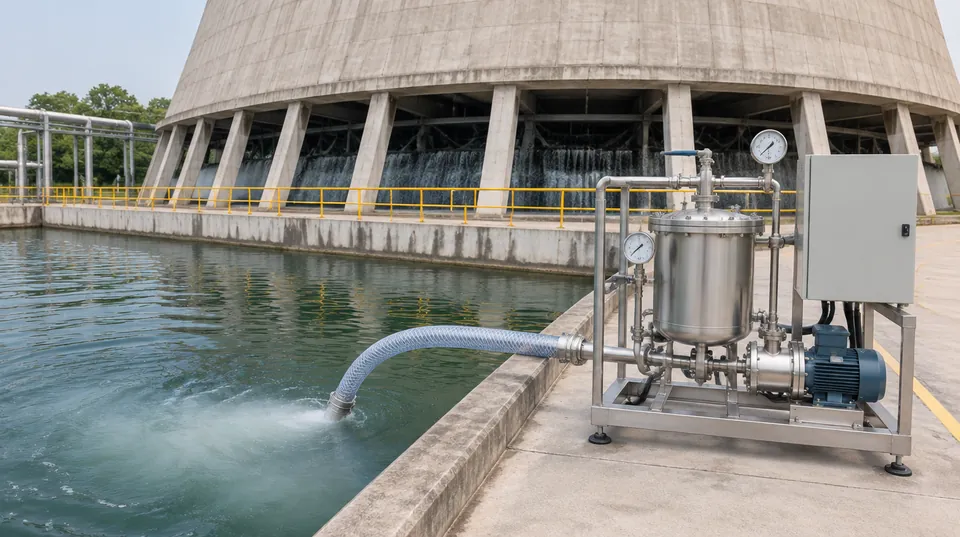
How a pilot on your tower would run
- Baseline for four weeks: conductivity, COC, blowdown volume, chemical use, bacteria counts and heat-exchanger approach temperature.
- Install the skid on a side stream from the basin; no shutdown of the tower.
- Run and log the same readings, with chemical dosing kept as it is at first.
- Step down biocide or inhibitor only where the readings hold, one change at a time.
- Compare: water saved through higher COC, chemicals saved, and tube condition at the next inspection.
What to send us
- Tower type and circulation rate, and the cooling range (hot and cold water temperatures)
- Make-up water source and analysis: hardness, alkalinity, silica, conductivity, total dissolved salts
- Current cycles of concentration and blowdown control
- Chemical programme and monthly use
- Recent problems: scale on tubes, slime on fill, high bacteria counts, approach temperature rising
Cooling tower water treatment: FAQ
How often should a cooling tower be blown down?
Most towers blow down continuously or in short bursts controlled by a conductivity setpoint, rather than on a timetable. The setpoint fixes the cycles of concentration; blowdown volume then follows from evaporation and COC. Raising COC saves water only if scale stays under control.
What causes Legionella in cooling towers?
Water held between about 25 and 45 °C, biofilm that shelters the bacteria, and stagnant pipe runs. Control rests on keeping surfaces clean, a steady biocide programme, regular bacteria testing, and drift eliminators in good condition.
Does Avior have a cooling tower installation?
Not yet. Our installations so far are in wastewater, lakes, turf irrigation and aquaculture. For cooling towers we offer a measured pilot on one tower, logged against a four-week baseline, so the decision rests on your own readings.
Scale or slime in your cooling tower?
Tell us the tower's circulation rate, make-up water hardness and current cycles of concentration. We reply within one working day.
Not sure whether nanobubbles suit your cooling tower?
Send the tower's circulation rate, make-up water analysis and current chemical programme. An engineer will tell you whether a pilot is worth running.