
Why oxygen is the first limit in fish farming
In an intensive pond or tank, three things happen together as the season warms and the fish grow. Fish eat more and breathe harder. Uneaten feed and waste feed bacteria that use oxygen too. And warm water holds less dissolved oxygen to begin with. The result is that dissolved oxygen falls fastest just before dawn, when the pond has had a night of respiration and no photosynthesis to top it up.
Low oxygen rarely kills the whole pond at once. It first stops fish feeding, which slows growth and wastes feed, and it lets ammonia build because the bacteria that convert ammonia need oxygen. Mortality comes last. That is why a trial should record morning oxygen, ammonia and feed use, and not only the harvest.
The two pilots
Both used air-fed nanobubble generators in the NanoAer 10 class (1.6 kW, 10 LPM of gas, 15 m³/hr of water).
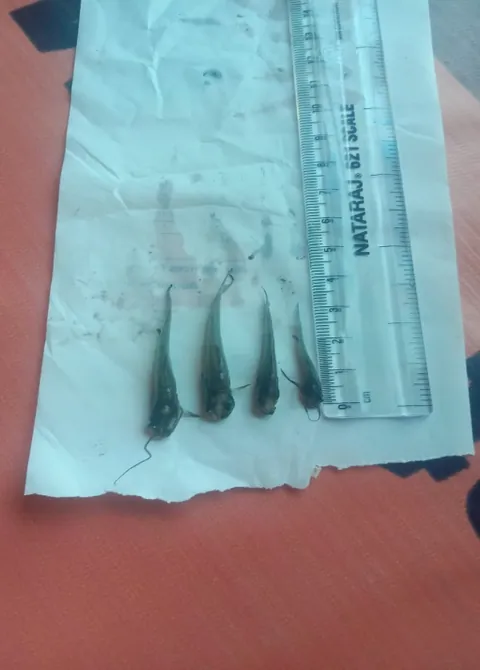
- Tengra tank trial, Hajo, Assam. Three 10,000-litre tanks over 100 days from November 2025: a control with 3,000 fish, a nanobubble tank with 3,000 fish and a nanobubble tank with 6,000 fish. See the full case study.
- Carp pond pilot, Nadipar, Assam. One 0.5-acre earthen pond stocked with rohu, mrigal, grass carp and catla, over 100 days from April 2026. There was no control pond. See the full case study.
What the tank trial shows
At day 100, morning dissolved oxygen was 6.0 mg/L in the control and 8.2 and 7.8 mg/L in the two nanobubble tanks. Morning ammonia was 0.55 mg/L in the control against 0.22 and 0.30 mg/L. Survival was 88% in the control and 95% and 92% in the nanobubble tanks. Feed conversion ratio was 0.85 in the control and 0.65 and 0.55 in the nanobubble tanks, so the fish converted feed into biomass more efficiently.
The double-density tank is the most interesting result. It held twice as many fish as the control and still showed better survival and a lower FCR. Biomass per 1,000 litres was 0.607 kg in the control and 1.766 kg in that tank. If the oxygen explanation holds, it suggests oxygen was limiting the carrying capacity of the control tank.
Why the tank trial is not a clean test
The control tank ran conventional aeration for 12 hours a day and had 30% of its water exchanged each week. The nanobubble tanks ran 24 hours a day with 15% exchange. So the nanobubble tanks had twice the aeration hours and half the water exchange. More aeration hours would be expected to help on their own, and less exchange changes the water chemistry. We cannot separate the effect of the nanobubble generator from the effect of the different operating conditions.
Other limits: the tanks were small, the fish were fingerlings of a few grams, there was one tank per treatment with no replicates, and the species and season were single. The report itself recommends a repeat cycle before any commercial scale-up.
What the pond pilot shows
Dissolved oxygen rose from 3.5 mg/L on day 1 to 7.6 mg/L on day 90. Ammonia fell from 1.0 ppm to not detected. pH moved from 6.2 to 7.6. Total biomass grew from about 130 kg to about 453 kg by day 100, while the water was recorded as clean. Grass carp grew from 75 g to 1,020 g.
The weakness is the missing control. Fish grow in summer whether or not a nanobubble generator is running, and water temperature rose from 26 to 35 °C over the cycle. We also have only the first and last water readings, no survival counts and no feed records, so we cannot calculate FCR or return on investment.
What the two pilots suggest together
The tank trial has a control but unequal conditions. The pond has realistic conditions but no control. Each covers the other's weakness a little, and both point the same way: higher and steadier dissolved oxygen, lower ammonia, and fish that grow well at higher loads. That is a reason to run a proper trial. It is not evidence that nanobubble aeration beats a well-run conventional system.
How we would design the next trial
- Two or more matched ponds or tanks with the same stocking, feed and water exchange. Only the aeration method differs.
- Dissolved oxygen recorded at dawn and in the evening, every day, with calibrated instruments.
- Ammonia, nitrite, nitrate, pH, temperature and ORP at fixed intervals.
- Feed logged by pond, survival counted at harvest, and FCR calculated from records.
- Power metered at each aerator, so energy per kilogram of fish can be compared.
- Targets written down before the cycle starts.
Questions farmers ask
Will this let me stock more fish? The double-density tank hints that oxygen can raise carrying capacity, but one tank is not a basis for changing your stocking plan. Raise density in steps and watch dawn oxygen and ammonia.
Can I switch off my paddle-wheels? We would not advise it on the strength of these pilots. Run the nanobubble generator alongside your current aeration first and compare.
What does it cost to run? The nameplate draw of a NanoAer 10 is 1.6 kW, which is up to 38.4 kWh over 24 hours of continuous running. We have not metered real consumption in these pilots, so treat that as an upper bound and meter it in your own trial.
What we have not tested
We have no published data on shrimp, saltwater culture, recirculating systems at commercial scale, or ponds treated with other aeration methods in parallel. If your farm runs those, a pilot would be a first test, not a repeat of ours.
If you would like to run a trial like the one above, talk to an engineer or read about nanobubbles in aquaculture.