
Tengra tank trial at the Hajo Biofloc Centre, Assam
A 100-day trial with a control tank and two nanobubble tanks. Clear signals on oxygen and ammonia, with a caveat on how the tanks were run.
Summary
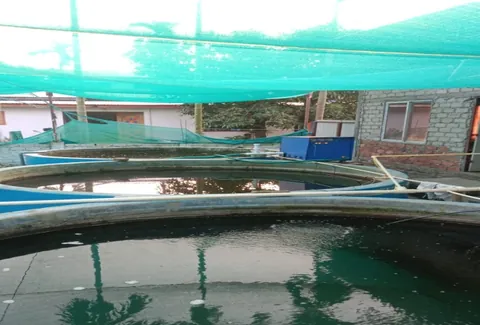
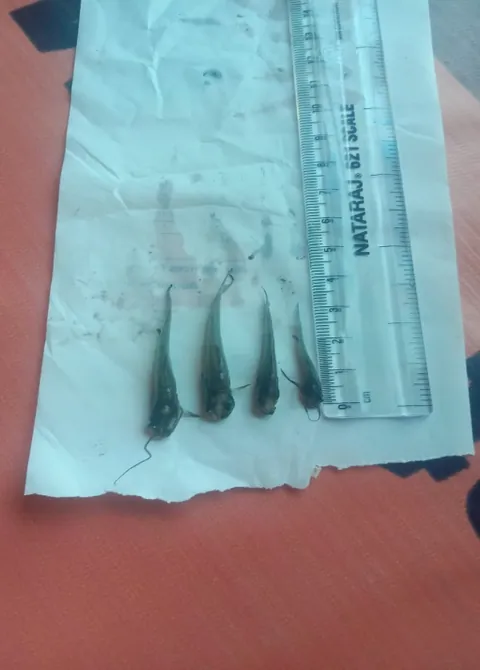
At the Hajo Large Biofloc Centre in Kamrup, Assam, we ran a 100-day trial on Tengra (Mystus) fingerlings in three 10,000-litre tanks: one control and two nanobubble tanks, one at double density.
At day 100 the nanobubble tanks had higher dissolved oxygen, lower ammonia, higher survival and a lower feed conversion ratio than the control. The control tank did not match the nanobubble tanks on aeration hours or water exchange, so the result is supportive, not a clean test of the nanobubble generator alone.
- Supervising body
- District Fisheries Office, Kamrup (supervising body)
- Location
- Hajo Large Biofloc Centre, Kamrup, Assam
- Trial
- 15 November 2025 to 25 February 2026 (100 days)
- Equipment
- One Avior Aqua 10 LPM air nanobubble generator (NanoAer 10 class: 1.6 kW, 10 LPM, 15 m³/hr)
- Species
- Tengra (Mystus), 0.35 g average starting weight
Design and conditions
| Tank | Treatment | Fish stocked | Volume |
|---|---|---|---|
| T1 | Control | 3,000 | 10,000 litres |
| T2 | Nanobubble | 3,000 | 10,000 litres |
| T3 | Nanobubble | 6,000 | 10,000 litres |
| Condition | Control | Nanobubble tanks |
|---|---|---|
| Aeration | Conventional air, 12 hours a day | Nanobubble, 24 hours a day |
| Water exchange | 30% weekly | 15% weekly |
Results
| Measure | Control | Nanobubble, 3,000 fish | Nanobubble, 6,000 fish |
|---|---|---|---|
| Dissolved oxygen, morning, day 100 (mg/L) | 6.0 | 8.2 | 7.8 |
| Dissolved oxygen, evening, day 100 (mg/L) | 5.5 | 7.9 | 7.5 |
| Ammonia, morning, day 100 (mg/L) | 0.55 | 0.22 | 0.30 |
| Nitrite, morning, day 100 (mg/L) | 0.20 | 0.08 | 0.12 |
| Nitrate, morning, day 100 (mg/L) | 22 | 14 | 16 |
| Turbidity, day 100 (NTU) | 9.8 | 6.5 | 7.0 |
| Survival (%) | 88 | 95 | 92 |
| Average final weight (g) | 2.3 | 3.0 | 3.2 |
| Specific growth rate (%/day) | 2.1 | 2.8 | 2.95 |
| Total biomass (kg) | 6.07 | 8.55 | 17.66 |
| Feed supplied (kg) | 5.2 | 5.8 | 9.2 |
| Feed conversion ratio | 0.85 | 0.65 | 0.55 |
Survival was 88% in the control and 95% and 92% in the nanobubble tanks. Feed conversion ratio was 0.85 in the control and 0.65 and 0.55 in the nanobubble tanks. Biomass per 1,000 litres was 0.607 kg in the control and 1.766 kg in the double-density nanobubble tank.
What this data does not show
- The control ran conventional aeration for 12 hours a day with 30% weekly water exchange. The nanobubble tanks ran 24 hours a day with 15% exchange. The trial does not isolate the nanobubble generator.
- Small tanks and fingerlings of a few grams. Results may not transfer to grow-out ponds.
- One species at one site, in winter, with one tank per treatment and no replicates.
- We calculate improvements from the table values. The report's own summary percentages are different, and we do not use them.
- The report recommends a repeat cycle, including a pond trial, before commercial scale-up.
Want similar data for your site?
We start with an assessment, agree what to measure, then run a pilot.