
Oxygenation for biofloc and RAS fish farms
Biofloc tanks and recirculating systems carry far more fish per litre than a pond, so dissolved oxygen becomes the first limit. Here is where a nanobubble unit fits, what we measured at a biofloc centre, and how a pilot runs.
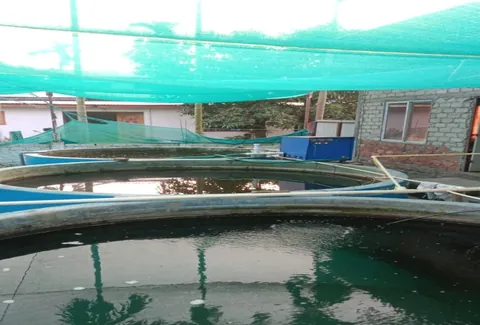
Why oxygen is the limit in biofloc and RAS
Biofloc and recirculating aquaculture systems hold far more fish in a given volume of water than an earthen pond. That density is the point of the system, and it is also why dissolved oxygen becomes the first limit. The fish respire around the clock, and the feed that drives their growth adds a further oxygen demand as it is eaten and digested.
In biofloc, the floc itself is a dense community of bacteria that turns ammonia and waste into microbial protein. Those bacteria need oxygen too, so a biofloc tank carries two oxygen loads at once: the fish and the floc. In a RAS, the biofilter plays the same role, and its nitrifying bacteria draw on the same oxygen as the fish.
Demand is not steady. It rises after each feed, as the fish digest and the floc or biofilter processes the waste, and it continues through the night. Dissolved oxygen is usually lowest in the early morning. A reading taken at midday can look comfortable while the tank is close to its limit before dawn, which is why morning readings tell you more than any single daytime value.
When oxygen runs short, fish eat less and convert feed less efficiently, ammonia conversion slows, and in the worst case stock is lost overnight. Holding oxygen steady through the feeding and night-time dips is the job of an oxygenation system.
Nanobubbles for aquaculture: what we measured at the Hajo Biofloc Centre
At the Hajo Large Biofloc Centre in Assam, the two tanks served by an air-fed nanobubble unit had higher morning and evening dissolved oxygen, lower morning ammonia and higher survival than the control at the end of the trial. The control was run differently, so the result is supportive, not proof.
| Measure | Control | Nanobubble, 3,000 fish | Nanobubble, 6,000 fish |
|---|---|---|---|
| Dissolved oxygen, morning (mg/L) | 6.0 | 8.2 | 7.8 |
| Dissolved oxygen, evening (mg/L) | 5.5 | 7.9 | 7.5 |
| Ammonia, morning (mg/L) | 0.55 | 0.22 | 0.30 |
| Survival (%) | 88 | 95 | 92 |
Where a unit fits in a biofloc tank or RAS loop
A nanobubble unit runs as a side-stream. It draws water from the culture tank or, in a RAS, from the sump, passes it through the generator and returns it carrying gas as bubbles under 200 nm. Because the bubbles stay in the water rather than rising straight to the surface, more of the gas has time to dissolve.
The unit runs alongside the blowers or diffusers you already have. It does not replace them: in a biofloc tank the existing aeration also keeps the floc in suspension, and in a RAS the existing system is designed for the whole loop. What a nanobubble unit adds is a steadier supply of dissolved oxygen through the feeding and night-time dips.
In the Hajo trial, the nanobubble tanks were served by an air-fed 10 LPM unit, which needs no oxygen supply. The right unit for your system depends on tank volume, stocking and your dissolved-oxygen target, and we confirm it after a site visit. See the nanobubble generator range.
Shrimp farms and hatcheries
Shrimp farms and hatcheries face the same oxygen limits: dense stocking, demand that rises with feeding, and dips through the night. We have not yet run a shrimp or hatchery trial, so we do not quote results for either. For a shrimp farm or hatchery, we propose a pilot with measurements agreed before installation and a matched control.
What to measure in a pilot
- Dissolved oxygen, morning and evening.
- Ammonia, nitrite and nitrate.
- pH and temperature.
- Survival.
- Feed supplied, and feed conversion ratio.
- Power use, metered at the unit.
- A matched control tank with the same aeration hours and water exchange.
Why each measurement matters
Morning dissolved oxygen shows how close the system comes to its limit, and evening readings show how much margin it carries into the night. Ammonia, nitrite and nitrate show whether the floc or biofilter is keeping pace with the feed going in. Survival and feed records turn water quality into the figures a farm is actually run on. Metered power gives a running cost based on what the unit draws in service, not on its nameplate.
The matched control is what makes the result usable. Without it, a better crop could come from the season, the stocking or the feed rather than the oxygen. With these records, a pilot answers the question the Hajo trial could not: what the nanobubble unit adds when everything else is held the same.
Biofloc and RAS oxygenation FAQ
Does a nanobubble unit replace my blowers?
No. It runs alongside your existing blowers or diffusers, which also keep the floc in suspension. We size the unit after a site visit.
Air or oxygen feed for biofloc and RAS?
Air-fed units run without an oxygen supply. Oxygen feed reaches higher dissolved oxygen. The choice depends on your stocking and your target dissolved oxygen. Compare the nanobubble generator range.
Have you tested it in shrimp?
Not yet. A pilot with agreed measurements and a matched control is the first step.
What does a pilot involve?
An assessment of your system, measurements agreed in advance, a matched control tank, and a report of the results. Request a site assessment.
Running a biofloc or RAS system?
Tell us your tank volumes, stocking and current aeration. We will propose a pilot with a matched control.