
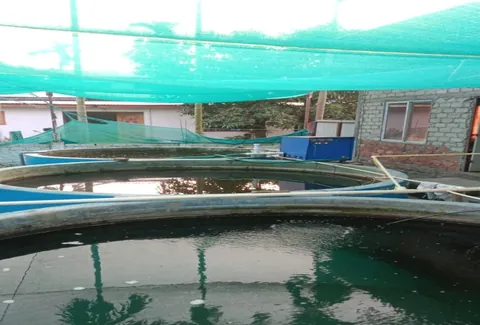
In biofloc tanks and recirculating aquaculture systems, oxygen runs out faster than in ponds. The fish are stocked densely, the water carries a heavy microbial load, and there is little natural buffer when something goes wrong. This guide covers the dissolved-oxygen targets these systems work to, when and why oxygen drops, how quickly a failure becomes a fish kill, and how to monitor. For the equipment side, see our page on oxygenation for biofloc and RAS fish farms.
What dissolved oxygen level do fish need in biofloc and RAS?
For acceptable growth in a recirculating system, published guidance is to hold culture-tank dissolved oxygen at 5 mg/L or higher, depending on the species. NSW fisheries guidance for silver perch notes that long exposure to sub-lethal levels below 3 mg/L reduces growth and stresses fish. Species and life stages differ, so follow the guidance for the fish you farm.
Treat the target as a floor for the lowest reading of the day, not as an average. Dissolved oxygen swings through every twenty-four hours, and it is the low point, usually around dawn, that decides whether fish feed well or spend the morning under stress. A tank that averages comfortably above target can still dip below it for hours before sunrise.
Why does oxygen drop at night and after feeding?
In ponds, dissolved oxygen is lowest around dawn, because photosynthesis stops at night while algae, sediment and fish keep consuming oxygen. In biofloc, the water itself uses oxygen quickly because of its microbial load. In every system, feed drives oxygen demand. That makes dawn and the hours after feeding the critical times to check.
In indoor biofloc systems, water respiration is normally about 6 mg O₂/L per hour. That is a heavy and constant demand, and it is why biofloc needs intensive mixing: solids must stay suspended, because settled floc consumes the oxygen around it and creates anaerobic zones. A dead corner in a biofloc tank is an oxygen problem as well as a mixing problem.
Feeding adds a second, predictable peak. As fish digest and the floc or biofilter processes the waste, oxygen demand rises after each feed. The next section shows how large that demand is in a recirculating system.
How fast can a biofloc or RAS system crash?
Very fast. In biofloc, the response time after a system failure is often less than 1 hour. In RAS, an oxygen or aeration failure can cause total fish loss within 30 minutes unless backup is provided. That is why alarms, backup power and backup aeration matter as much as the main aeration system itself.
For biofloc, extension guidance goes further: monitoring, alarms and emergency power are required elements, and biofloc is not a good choice where the power supply is unreliable. In practice that means a dissolved-oxygen alarm on every critical tank, emergency power that does not depend on someone being on site, a backup source of aeration that does not depend on the main blower, and a written plan for who responds at night.
How much oxygen does feed consume in a RAS?
In a recirculating system, roughly 0.3 kg of oxygen is consumed for every 1.0 kg of feed where solids are removed quickly, and up to 1.0 kg where solids stay in submerged biofilters. So for every 10 kg of feed, plan for roughly 3 to 10 kg of oxygen a day, depending on how fast solids leave the system.
Two things follow. First, oxygen demand rises with the feeding rate, so a farm that increases stocking or feed should check its oxygen supply before it does. Second, removing solids quickly lowers the oxygen the system has to supply, because less waste is left to break down inside it.
Air or pure oxygen?
It depends on stocking density. Air aeration typically supports up to about 30–40 kg of fish per m³. Above about 40 kg/m³, farms generally move to pure oxygen, which raises the saturation concentration nearly fivefold. That extra headroom is what lets dissolved oxygen stay up at densities that air alone cannot support.
Pure oxygen is added with equipment such as oxygen cones, low-head oxygenators and diffusers. Oxygen cones achieve nearly 100% absorption of the injected gas. Air-fed equipment needs no oxygen supply, which keeps it simpler to run. Our nanobubble generator range includes both air-fed and oxygen-fed units.
How to monitor dissolved oxygen
Good monitoring catches a falling trend before it becomes a crisis:
- Measure at dawn, when dissolved oxygen is lowest, and again in the evening and after feeding.
- Record every reading and chart the daily cycle, so you can see the pattern and predict low periods.
- Use a calibrated dissolved-oxygen meter, and check its calibration on a regular schedule.
- Keep alarms on critical tanks, tied to backup power and backup aeration.
Where you measure matters as much as when. In a biofloc tank, take readings away from the aeration point and near the bottom as well as near the surface. A well-mixed tank should read much the same everywhere, and a low reading in one spot points to settled solids and a dead zone. In a RAS, measure in the culture tanks themselves rather than only in the sump, because that is where the fish are. Note the time, the reading and anything that happened just before it, such as a feed or a power cut, so the chart can be read properly later.
What we measured at the Hajo Large Biofloc Centre
In our Tengra tank trial at the Hajo Large Biofloc Centre in Kamrup, Assam, dissolved oxygen was recorded in the morning and the evening. At day 100, morning dissolved oxygen was 6.0 mg/L in the control tank against 8.2 and 7.8 mg/L in the two nanobubble tanks. Evening readings were 5.5 mg/L in the control against 7.9 and 7.5 mg/L. The nanobubble tanks held higher dissolved-oxygen readings in the trial. The Tengra case study sets out how each tank was run.
What to do when DO is low
When readings fall, act on the oxygen first. Keep aeration running day and night and add aeration, reduce or stop feeding, exchange water, and remove dead plant and animal material from the water. Then look for the cause: a blower or pump fault, a feeding rate that has crept up, settled solids, or a power interruption.
For a longer-term fix in an intensive system, the answer is usually more oxygen capacity, delivered steadily through the night and after feeding. Our page on oxygenation for biofloc and RAS fish farms explains where a nanobubble unit fits alongside existing aeration, and how we run a pilot with a matched control.
Dissolved oxygen FAQ
What is the minimum DO for fish in biofloc?
It depends on the species. Published RAS guidance is to hold culture-tank DO at 5 mg/L or higher for acceptable growth. NSW fisheries guidance notes that long exposure below 3 mg/L reduces growth and stresses fish. Follow the guidance for your species and life stage.
When should I measure DO?
At dawn, when it is lowest, and again in the evening and after feeding. Chart the readings so you can see the daily cycle.
Do I need pure oxygen in RAS?
Not always. Air aeration typically supports up to about 30–40 kg of fish per m³. Above about 40 kg/m³, pure oxygen is generally used.
How quickly do fish die if aeration stops?
Quickly. In RAS, an oxygen or aeration failure can cause total fish loss within 30 minutes unless backup is provided. In biofloc, the response time after a failure is often less than 1 hour.
Sources
- Losordo, T. M. (2014). A look at unit processes in RAS systems. Global Aquaculture Advocate, Global Seafood Alliance. www.globalseafood.org
- NSW Department of Primary Industries. Monitoring dissolved oxygen. www.dpi.nsw.gov.au
- Hargreaves, J. and Brunson, M. (1996). Carbon Dioxide in Fish Ponds. SRAC Publication No. 468. srac.tamu.edu
- Hargreaves, J. A. (2013). Biofloc Production Systems for Aquaculture. SRAC Publication No. 4503. aquaculture.mgcafe.uky.edu
- Avior Aqua. Tengra tank trial, Hajo Large Biofloc Centre. Read it