
Fermentation oxygen: yeast propagation, wort aeration and aerobic fermenters
Every aerobic fermentation is limited by how fast oxygen reaches the cells, and supplying it can account for about 15% of production cost. Fine bubbles solve this. With a microbubble dispersion, brewer's yeast grew almost twice as fast as with air sparging. This guide covers where oxygen matters in brewing, distilling, yeast production and precision fermentation, and how nanobubble oxygen delivers more of it.
Why does yeast propagation need oxygen?
Yeast needs oxygen to make the sterols in its cell membrane, so propagation is aerobic. In brewing, cooled wort is typically oxygenated to about 8 to 10 mg/L before pitching, and the main fermentation then runs without oxygen. Too little oxygen gives weak yeast and slow fermentation.
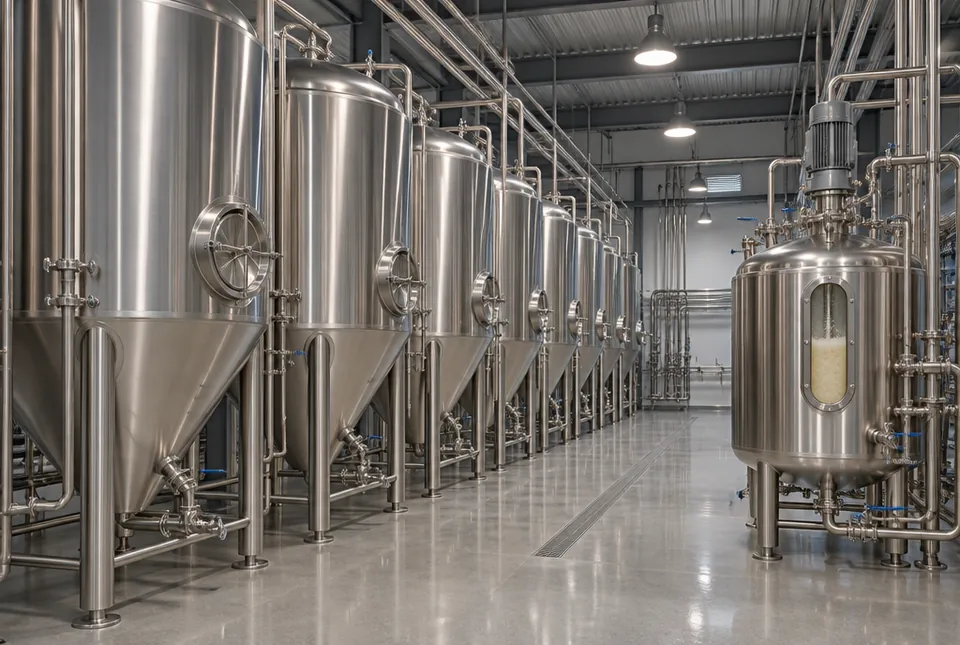
Where oxygen matters in each process
| Process | When oxygen is needed | Usual method |
|---|---|---|
| Brewing | Wort before pitching | Air or oxygen stone in the wort line |
| Distillery yeast propagation | Throughout propagation | Air sparger or venturi into the propagator |
| Baker's and feed yeast | Throughout growth | Air sparging with high agitation |
| Precision fermentation | Throughout, at high cell density | Air or oxygen, agitation and back pressure |
Why oxygen transfer becomes the limit
At high cell density, cells use oxygen faster than coarse bubbles can dissolve it, so dissolved oxygen becomes the limit. Plants push back with more air, pure oxygen, faster agitators or higher pressure. Each of these costs energy or adds shear stress on the cells. For precision fermentation, where engineered microbes make specific proteins in aerobic fermenters, oxygen transfer often decides how dense the culture can grow.
Fine bubbles transfer more oxygen and grow more yeast
Smaller bubbles have far more surface area and rise slowly, so more oxygen dissolves before they escape. In yeast, that shows up as faster growth: a microbubble dispersion almost doubled the growth rate against air sparging and held dissolved oxygen above zero where coarse bubbles let it fall. The results in yeast:
- Growth rate almost doubled: 0.108 per hour with a microbubble dispersion against 0.068 per hour with air sparging.
- Oxygen transfer coefficient about 190 per hour with a microbubble dispersion, whatever the impeller speed, against 55 to 132 per hour for air sparging.
- Growth 18% more efficient after 6 hours with microbubble aeration in an airlift bioreactor. Dissolved oxygen stayed above zero, ending the oxygen starvation seen with coarse bubbles.
- At 50 litres pilot scale, microbubble aeration improved cell mass yield, growth rate and power consumption over conventional sparging.
The gain is in propagation and aerobic growth, where oxygen is the limit. The yeast that goes into the anaerobic ethanol stage is healthier and ready sooner.
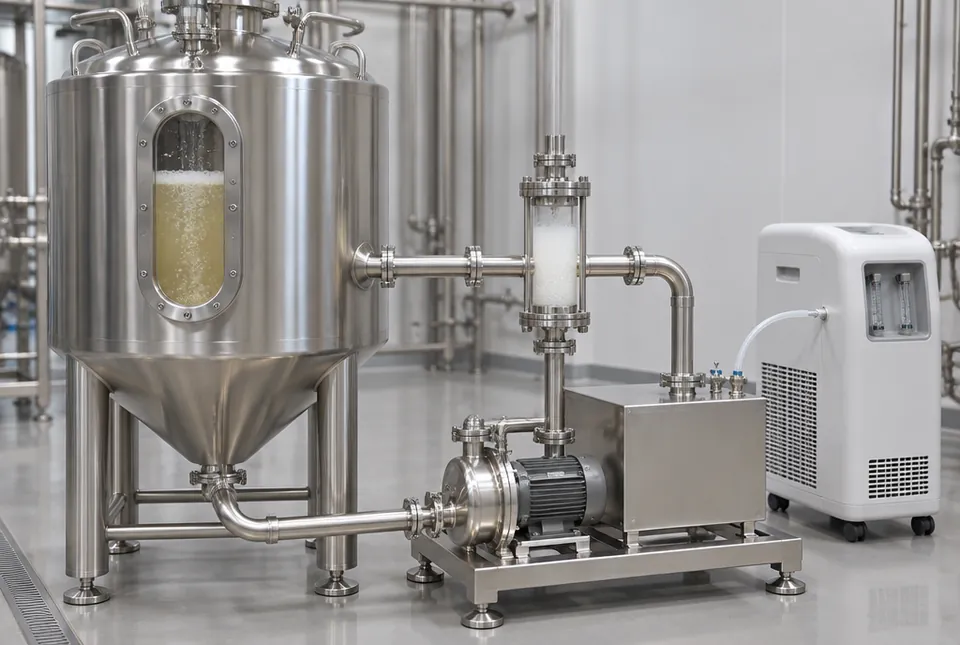
Built for hygiene
Gas going into a food or beverage fermenter is food grade and sterile-filtered, and everything in contact with product is sanitary-grade and cleanable in place. Avior's generator runs on a closed side loop with a sanitary pump and sterile gas. See our nanobubble generators.
What to send us
- Organism and process (beer, distillery, yeast, precision fermentation)
- Vessel volumes and batch times
- How oxygen is added today, and the dissolved oxygen reached
- Cell count, viability and any stuck or slow fermentations
- Cleaning regime (CIP) and materials of construction
Fermentation oxygen: FAQ
What is wort aeration?
It means adding air or oxygen to cooled wort before the yeast is pitched. The target is commonly about 8 to 10 mg/L of dissolved oxygen, which the yeast uses to build healthy cell membranes.
Does better oxygen transfer speed up fermentation?
Yes, in the aerobic stage. Yeast grew almost twice as fast with a microbubble dispersion than with air sparging, and microbubble aeration was 18% more efficient in growth yield after 6 hours. Ethanol itself is made without oxygen, so the gain comes from healthier yeast reaching the fermenter sooner.
What is precision fermentation?
It uses engineered yeast, fungi or bacteria to make specific proteins or ingredients, mostly in aerobic fermenters where oxygen transfer limits growth.
Oxygen limiting your propagation or fermenter?
Tell us the vessel size, organism, how you add oxygen today and the dissolved oxygen you reach. We reply within one working day.
Oxygen limiting your propagation or fermenter?
Send the vessel size, organism, how you add oxygen today and the dissolved oxygen you reach. An engineer will tell you how a nanobubble side loop fits your process.