
CBG plant in India: how the sector works and why plants run below design
India's compressed biogas sector now has an assured market. GOBARdhan was approved on 6 August 2026 with ₹23,731 crore for ten years, and city gas companies must buy CBG at 3% in FY 2026-27, rising to 5% from FY 2028-29. The constraint is output. In November 2026, India's functional CBG plants produced 44% of the gas they were built for. This guide covers how a CBG plant works, what the schemes mean for owners, and how nanobubble water raises methane yield from the same feed.
What is a CBG plant?
A CBG plant turns organic waste into vehicle-grade gas. Paddy straw, press mud, dung or food waste is digested without air to make raw biogas of about 50 to 65% methane. The gas is cleaned to above about 90% methane, compressed and sold as CBG, and the digestate is sold as organic manure.
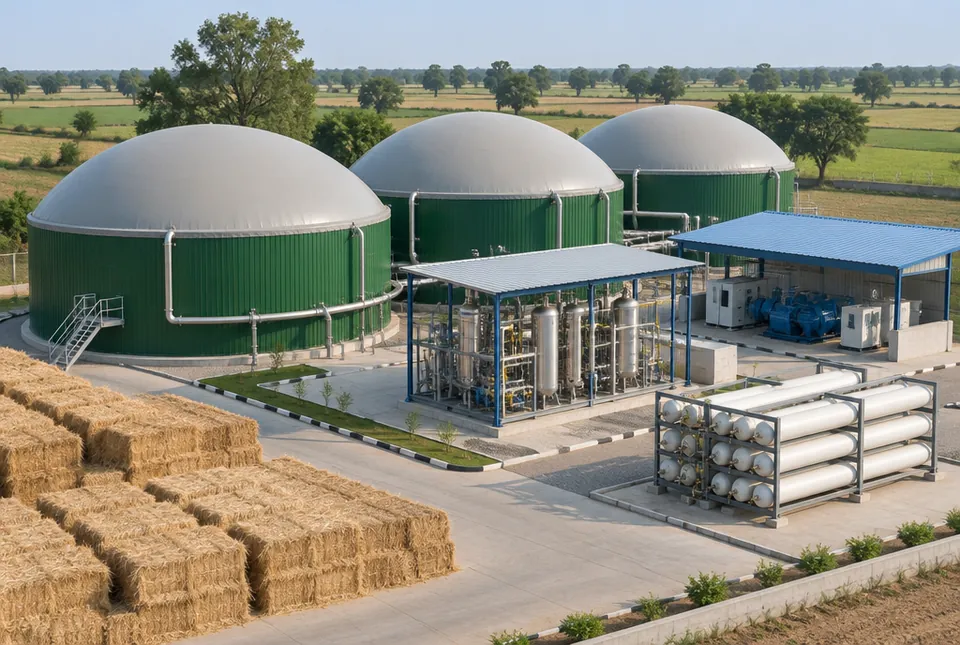
How a CBG plant works, step by step
| Stage | What happens | What limits it |
|---|---|---|
| Feed preparation | Chopping, soaking, mixing and other pre-treatment | Straw needs the most preparation |
| Digestion | Bacteria break the feed down without oxygen | Temperature, loading, mixing, inhibitors |
| Gas upgrading | CO2, H2S and moisture are removed | Raw gas volume and quality |
| Compression and sale | Gas goes to cascades, a pipeline or a dispensing station | Pipeline access |
| Manure | Digestate is sold as organic manure | Farmer demand |
What are SATAT and GOBARdhan?
SATAT began on 1 October 2018 with the aim of 5,000 CBG plants. GOBARdhan, approved in August 2026, brings CBG support under one central scheme for FY 2026-27 to FY 2035-36, and aims to raise domestic CBG production nearly ten-fold.
For a plant owner, the most important part is the CBG Obligation. City gas distribution companies must buy CBG equal to:
- 3% in FY 2026-27;
- 4% in FY 2027-28;
- 5% from FY 2028-29.
With the buyer assured, every extra cubic metre of methane a plant makes is revenue.
Why do CBG plants run below design capacity?
Most plants run well below design because feed, digestion or offtake falls short. In PNGRB's November 2026 data, 210 functional plants with 2,212 tonnes a day of design capacity were producing 982 tonnes: 44%. Plants with a pipeline connection ran at 65%, and those without one at 40%.
Pipeline access is one cause. The others sit inside the plant fence:
- feed that is hard to digest;
- overloading;
- winter temperature drops;
- poor mixing;
- inhibitors such as ammonia and sulphide.
Our guide to CBG plant biogas yield sets out the checks that find each one.
Feedstock and cost
Each feedstock digests at its own rate and needs its own pre-treatment. Straw costs the most to build for. CSE puts paddy-straw plants at about ₹6 to 7 crore per tonne of daily capacity, against about ₹5 crore for dung, municipal waste or press mud, because of the extra pre-treatment for silica and lignin. When a straw plant runs at half its design, the extra capital earns nothing, so output matters most here.
Nanobubble water raises methane yield
Nanobubble water raises the methane a digester gets from the same feed, whether the feed is rice straw, sludge or lignin. Across published studies the gains run from 11.0% to 37.1%, with the bubbles added as water rather than gas. Results from published studies:
| Feed | Nanobubble water | Methane gain |
|---|---|---|
| Rice straw | Oxygen nanobubbles | +18.3% |
| Rice straw (soaking and accelerant) | Nanobubble water | +11.0% to +21.4% |
| Waste activated sludge | Air, N2, CO2 or H2 ultra-fine bubbles | +14% to +21% |
| Lignin | N2 nanobubbles | +22% |
| Pre-treated sewage sludge | Nanobubble water | up to +37.1% |
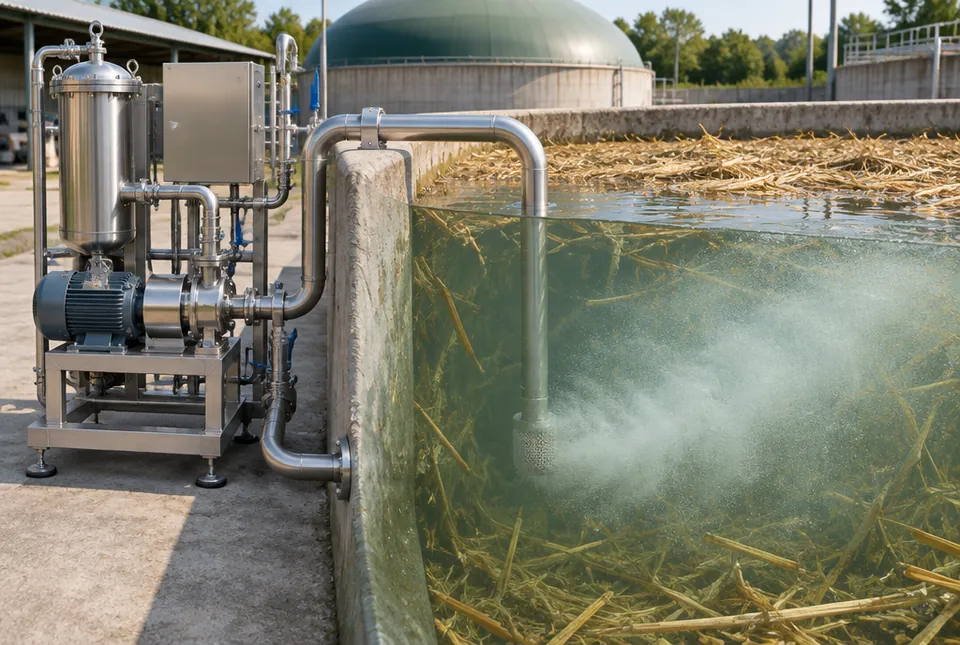
The bubbles speed up the breakdown of tough fibre and raise the activity of the microbes that make methane. They go in as water, in the straw soaking tank or as a measured dose to the digester. Air is never blown into a working digester.
How Avior fits a CBG plant
An Avior nanobubble generator is a skid that sits outside the tanks and is serviced above ground. It feeds nanobubble water to the straw soaking tank or doses the digester feed line, with no change to the digester itself. Our engineers size it from your feed rate and digester volumes.
What to send us
- Feedstock mix, daily quantity and any analysis
- Design capacity (tonnes a day of CBG) and actual output over the last three months
- Number and volume of digesters; pre-treatment in use
- Pipeline or cascade offtake
- Problems seen: foaming, souring, winter drop
CBG plant in India: FAQ
What is the CBG blending obligation?
City gas distribution companies must procure CBG at 3% in FY 2026-27, 4% in FY 2027-28 and 5% from FY 2028-29 onwards. That gives CBG plants an assured buyer for their gas.
How much does a CBG plant cost in India?
CSE puts it at about ₹5 crore per tonne of daily capacity for dung, municipal waste or press mud, and about ₹6 to 7 crore for paddy straw. Actual cost depends on the site, the technology and the offtake.
What is the difference between biogas and CBG?
Biogas is the raw gas from the digester, about 50 to 65% methane. CBG is that gas cleaned to above about 90% methane and compressed.
Does nanobubble water increase biogas production?
Yes. In published studies, nanobubble water raised methane yield by 18.3% from rice straw, by 14% to 21% from waste activated sludge and by up to 37.1% from pre-treated sewage sludge.
Planning or running a CBG plant?
Tell us your feedstock, design capacity and today's output. We reply within one working day.
Planning or running a CBG plant?
Send your feedstock, design capacity and today's output. An engineer will tell you where nanobubble water fits your plant and how the unit is sized.