
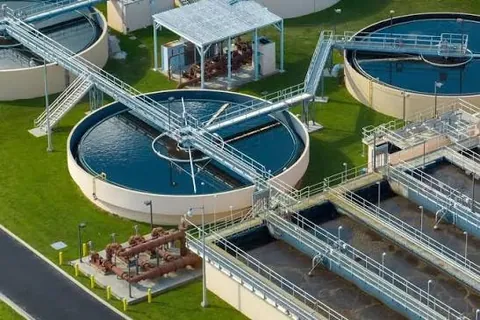
Aeration is the step that keeps the bacteria in an aeration tank alive and working. Without enough oxygen they stop breaking down the organic load in the sewage, and effluent quality falls. Aeration is also usually the largest electricity user in the plant: the U.S. EPA puts it at about 50–65% of a typical activated sludge plant's net power demand. This guide covers the main aeration methods, how they compare on published figures, and where nanobubble aeration fits.
What does aeration do in a sewage treatment plant?
Aeration does two jobs in a sewage treatment plant. It supplies oxygen to the bacteria in the aeration tank that break down the organic load, measured as BOD and COD. It also mixes the tank so that the activated sludge stays in suspension. If either job falls short, treatment slows and the effluent suffers.
The aeration tank is where most of the biological treatment in an activated sludge plant happens. Settled sewage enters the tank and mixes with returned sludge that carries the bacteria. The bacteria use the oxygen that the aeration system supplies to break the organic load down, which is why the plant is judged on how much BOD and COD leave it.
The mixing job matters as much as the oxygen. Sludge that drops out of suspension in a quiet corner of the tank is no longer treating sewage. So an aeration system is judged on how evenly it delivers oxygen across the tank, and not only on how much it delivers in total.
How much energy does aeration use?
Aeration is usually the largest single electricity user in a sewage treatment plant. The U.S. EPA puts it at about 50–65% of a typical activated sludge plant's net power demand, and a 2019 review reports a range of 50% to 90%. The range is wide because plants differ in size, load, equipment and how aeration is controlled.
The U.S. Department of Energy gives a simpler rule of thumb: aeration is about one-half of a treatment facility's energy use. Wherever a plant sits in that range, aeration is the first place to look when running costs need to come down, and the first place to measure before any change is made.
The main types of aerators in STPs
Most sewage treatment plants use one of three families of aeration equipment. They differ in how they get oxygen into the water, in how much oxygen they transfer for each unit of power, and in the maintenance they need.
Fine-bubble diffusers
Fine-bubble diffusers sit on the floor of the aeration tank and release air through membranes or porous elements as small bubbles, which give more surface area for the same volume of air. The U.S. Department of Energy lists their typical efficiency at about 6.5 lb O₂/hp-hr, the highest of the common types. In one field comparison at Ridgewood, New Jersey, average field oxygen transfer efficiency was about 9.5% for fine-pore diffusers.
The trade-off is maintenance. Fine-pore diffusers can foul chemically or biologically, which lowers transfer efficiency and raises head loss, so they need routine cleaning and the basins must allow for it.
Coarse-bubble diffusers
Coarse-bubble diffusers release larger bubbles through wider openings. They transfer less oxygen for each unit of power: the Department of Energy figure is about 2.0 lb O₂/hp-hr. In the same Ridgewood comparison, field transfer efficiency was about 4.8%, roughly half the fine-pore figure. Choosing between fine and coarse bubbles is therefore a trade-off between transfer efficiency and the cleaning that fine-pore diffusers need.
Surface and mechanical aerators
Surface aerators use a rotor or impeller at the water surface to splash and mix the tank, so oxygen enters at the surface while the tank is stirred. Published typical efficiencies are about 3.0 lb O₂/hp-hr for surface mechanical aerators, 2.8 for jet aerators and 2.0 for submerged turbine aerators.
| Type | lb O₂/hp-hr (as published) | kg O₂/kWh (converted) |
|---|---|---|
| Fine-bubble diffuser | 6.5 | 3.95 |
| Surface mechanical aerator | 3.0 | 1.82 |
| Jet aerator | 2.8 | 1.70 |
| Coarse-bubble diffuser | 2.0 | 1.22 |
| Submerged turbine aerator | 2.0 | 1.22 |
Why field oxygen transfer is lower than the brochure figure
Published efficiencies are measured in clean water under standard conditions. A real aeration tank holds mixed liquor full of solids and bacteria, and that reduces how much oxygen crosses from the bubble into the water. Engineers describe this with the alpha factor, the ratio of oxygen transfer in the plant's own water to transfer in clean water.
A 2019 review puts alpha typically between 0.5 and 0.9, depending on the sludge. The same review cites a comparison in one medium that found about 0.5 for fine bubbles and 0.8 for a surface aerator. In other words, the gap between the two narrows once they are working in real sludge.
Fouling adds a second loss over time. As fine-pore diffusers foul, their transfer efficiency falls and head loss rises, so the blowers push against more resistance for less oxygen. The Ridgewood field values of about 9.5% and 4.8% show how far field transfer can sit from a clean-water test. The practical point for an operator is to compare aeration options on field performance in your own tank, and to plan cleaning into the budget from the start.
What dissolved oxygen should an aeration tank hold?
There is no single correct figure for every plant. Many plants still run a fixed dissolved-oxygen setpoint of 1–3 mg/L in the aerobic zones, but a 2019 review calls fixed setpoints an outdated approach compared with DO control, because excess DO wastes energy. Check your plant's design basis and its consent conditions.
Your plant's design basis sets the oxygen its process needs, and your consent conditions set what the effluent must achieve. Between the two, measured DO profiles across the tank and through the day show whether aeration is matched to the load or simply running at a fixed rate. Where DO sits well above what the process needs, energy is being wasted. Where it falls low in parts of the tank, treatment in those zones suffers.
Where do nanobubbles fit?
A nanobubble unit runs as a side-stream beside an aeration tank. It adds gas to the water as bubbles under 200 nm that rise slowly and stay suspended, so the gas has longer to dissolve. It is an addition to a plant's existing aeration, and does not replace its blowers or diffusers.
Laboratory work points the same way. In lab-scale activated sludge reactors, a 2022 study found that air-nanobubble aeration reached a higher dissolved-oxygen level faster than coarse-bubble aeration and removed 10% more soluble COD for the same air supply, with more compact sludge. That was a lab-scale study, and plant-scale results can differ.
In our Pirana bench trial on raw sewage (3 to 5 December 2024), oxygen nanobubbles cut COD by 86%, BOD by 89% and TSS by 81%, and ozone nanobubbles brought E. coli below 2 MPN/100 mL. Dissolved oxygen did not rise with oxygen nanobubbles, going from 6.4 to 6.2 mg/L. It was a bench-scale trial, not a plant installation. We have not published a metered energy comparison at plant scale.
For sewage and effluent plants we use the NanOxy oxygen nanobubble generator, with an optional ozone unit where disinfection is needed. Our page on nanobubble STP aeration shows where a unit sits in a plant, and our guide to nanobubble technology explains how the bubbles behave.
What to check before upgrading aeration
Before changing any aeration equipment, gather the evidence that a fair comparison needs:
- Your current dissolved-oxygen profile across the tank and through the day, measured at several points.
- Blower or aerator power, metered rather than read from a nameplate.
- The age and condition of the diffusers, including any fouling.
- Influent load: flow, BOD and COD, and how they vary through the day and the year.
- Your discharge consent limits from the state pollution control board.
- Space beside the tank for a side-stream unit, with power and pipework.
- A pilot with a measured baseline, so any change can be compared with real numbers.
In April 2019 the National Green Tribunal directed stricter STP discharge standards to apply uniformly across the country and asked MoEF&CC to notify them. The limits that apply to your plant are the ones in your consent from the state pollution control board, so start there, and make the consent limits part of the targets you agree before a pilot.
Aeration FAQ
Why is aeration the most expensive part of an STP?
Aeration supplies the oxygen that biological treatment depends on, and it uses more power than any other step. The U.S. EPA puts it at about 50–65% of a typical activated sludge plant's net power demand, and a 2019 review reports 50% to 90%, depending on the plant.
Are fine-bubble diffusers better than surface aerators?
On published efficiency, yes: about 6.5 lb O₂/hp-hr for fine-bubble diffusers against 3.0 for surface mechanical aerators. But fine-pore diffusers foul and need routine cleaning, and oxygen transfer in real sludge is lower than the published figures. Compare the options on field performance in your own tank.
Can nanobubbles replace blowers?
No. A nanobubble unit runs as a side-stream addition to a plant's existing aeration. We size it after a site assessment, once we have measured the plant's dissolved-oxygen profile and load.
What discharge standards must an STP meet in India?
The limits in your consent from the state pollution control board. In April 2019 the National Green Tribunal directed stricter STP discharge standards to apply uniformly across the country. Check your consent conditions for the limits that apply to your plant.
Sources
- U.S. EPA (1999). Wastewater Technology Fact Sheet: Fine Bubble Aeration. EPA 832-F-99-065. webarchive.library.unt.edu
- Drewnowski, J. et al. (2019). Aeration Process in Bioreactors as the Main Energy Consumer in a Wastewater Treatment Plant. Processes 7(5), 311. doi.org
- U.S. Department of Energy (2021). Energy Tips: Wastewater Treatment Plants, Tipsheet #1: Utilize Fine-Bubble Diffusers in Aeration Tanks. industrialapplications.lbl.gov
- Avior Aqua. Nanobubble technology: what it is, and what it does not do. Read it
- Yaparatne, S. et al. (2022). Effect of air nanobubbles on oxygen transfer, oxygen uptake, and diversity of aerobic microbial consortium in activated sludge reactors. Bioresource Technology 351, 127090. doi.org
- Avior Aqua. Pirana STP bench trial, Ahmedabad. Read it
- India Environment Portal. Order of the National Green Tribunal regarding effluent discharge standards for STPs, 30 April 2019. indiaenvironmentportal.org.in